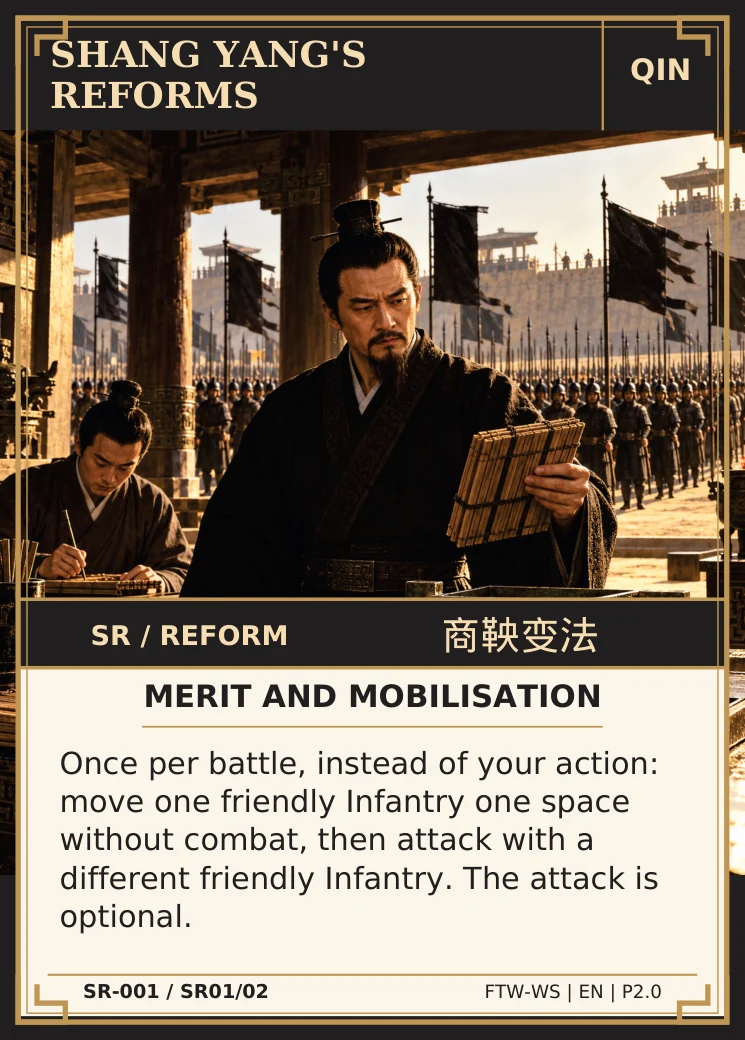
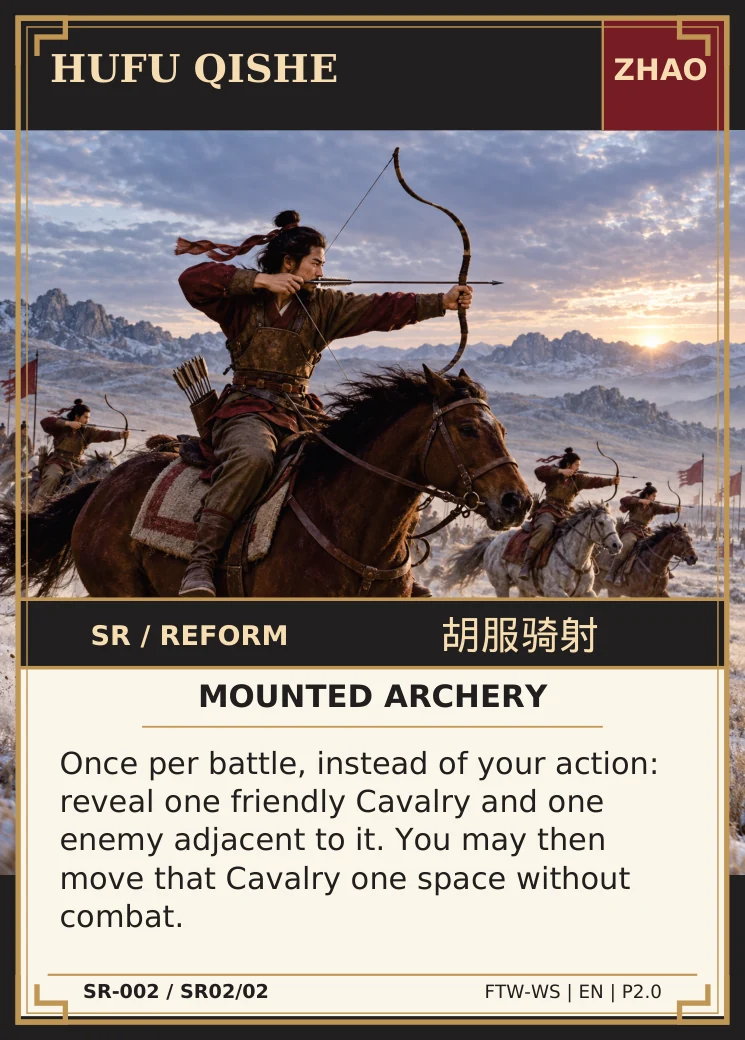
Choose your commander.
Each faction supplies two commanders; choose one for the match. Keep it face up beside the board. Its ability can be used once per battle.
A two-player game of concealed units, terrain and timing. The illustrated set is complete; the rules and optional reforms are still being playtested.
Eight explained scenarios. Reveal each move and see how abilities change the result.
Each faction supplies two commanders; choose one for the match. Keep it face up beside the board. Its ability can be used once per battle.
Use a 5 × 9 battlefield. Qin deploys its 15 army cards in rows 1–3; Zhao in rows 7–9. The Command Camps start at C1 and C9. Their locations are public. All army cards start face down.
Each player shuffles a separate 12-card stratagem deck and draws three. Randomly choose the first player, who skips their first draw. Use the fixed starter quantities.
Draw one at the start of your turn, then move or attack with a unit, use a Scout, play a stratagem, use an available action ability, or pass. Discard down to five cards at the end.
Declare an adjacent attack before revealing. Resolve any commander responses, then reveal both cards and compare effective Rank. Higher Rank survives; equal Ranks remove both units. A surviving attacker takes the defender’s space.
An attack against a Command Camp wins immediately. Camps never move or attack. Two consecutive passes, or the end of round 30 without a captured camp, produce a draw.
Select any space. This is the rules reference board, not a playable match or a historical map.
Select a terrain square to see its effect. Adjacency and movement are orthogonal—never diagonal. The two crossings are the only walkable spaces through the river row.
A concealed Zhao Hidden Detachment has Rank 3. Defending in Forest, it adds +2 for concealment at declaration and +1 for terrain: effective Rank 6. A Qin Veteran Guard attacks at 6 and cannot gain positive modifiers. Both are removed on the tie.
Read the Hidden Detachment ↗Both players must agree to use the reform module. Each places their own faction’s Reform face up beside their commander. It is not shuffled into a deck and is not a battlefield unit.
Use it once, instead of your normal action; rotate it when spent. The reform never refreshes. These are guaranteed bonus cards, not random rare pulls.
Explore both reforms ↗Use these documents for detailed timing, terrain exceptions, the fixed inventories and optional reform interactions.
60 physical cards = 58 core cards + 2 reforms. Each side receives 29 core cards but uses only one of its two commanders in a match. Identical opaque sleeves are required for concealed army cards.